Materials and application
Wholesale rhinestone trim by the metre, from heights to yardage
Which trim height fits a neckline, cuff or placket?
Neckline depth and curve radius change how trim sits. Place it on the attachment line with the shoulder seams closed in paper. Hold the inside edge down and see whether the outer edge lifts. On a straight placket, check the space between button line, buttonhole and decoration. The listed height is measured across the trim, at right angles to the length you buy.
For fine edging, 3S742 is a 5 mm hot-fix trim with two rows of 2 mm Crystal rhinestones. 3S474 is an 8 mm hot-fix trim with bordered rhinestones and braided lurex thread. Where a seam can take an insert, 3S364 is a 1.5 cm sew-on piping with rhinestone chain and micro beads. Mark on the pattern how much piping should show after assembly.
| Height | Placement to trial | Base, weight and curve behaviour | Codes and unit |
|---|---|---|---|
5–15 mm | Neckline, cuff or seam edge. | Check the two rows on the curve, shine on lurex and the depth of piping exposed at the seam. | |
18–35 mm | Placket, shallow neckline, shaped waistband. | Check whether the base follows the curve and the glass stones pull the cloth when hung. | |
38–60 mm | Eveningwear panel, waistband or straight section. | Hang the garment with ABS and rhinestones, seed beads with chain or bugle beads with rhinestones. Mark breaks in the curve. |
When would you use glass stones, ABS or a bugle-bead band?
Compare equal lengths and check the weight with the garment on a hanger. FC195 is a 1.8 cm hot-fix ABS and rhinestone trim in eight colourways A–H. 3S258 is hot-fix with glass stones, 2.5 cm high. FC161 is a 4 cm hot-fix trim made with ABS and rhinestones. Glass can put more load on the cloth at the same volume. The quantity of stones and the weight of the base also count, so weigh the mounted samples with the proposed support.
FC151 is a 5.8 cm hot-fix trim with seed beads and chain. FC150 is a 6 cm hot-fix trim with bugle beads and rhinestones. Trial these wider bands on a fairly straight line. Make up a join and look across it in low-angle light to see whether the motifs meet. Test the actual care process before signing off the label. Glass and ABS may respond differently to dry-cleaning solvents. Check coating, adhesive and thread as well, especially if the cloth will be pressed again.
For a buying comparison, weigh a 20 cm length of each trim out of its packaging and multiply by five for a rough weight per metre. Mark the distance from the garment’s nearest support seam to the trim. The same weight can pull a bias-cut panel farther from a seam more than an area supported just under the placement line.
Why does a wide trim buckle at the armhole?
The outside of a curve travels farther than the inside. If you constrain both edges of a band over 3 cm high on a tight armhole, the excess can wrinkle at the inside or tug on the outside. Trial it on the pattern with seams closed, then on basted cloth. Forcing a tight radius into a rigid rhinestone chain can rotate its settings. Brush a lining offcut over any prongs and mark where they pick up a thread.
If the curved trial lifts, flatten the pattern and correct the attachment line before measuring consumption. With some bases you can plan a dart or cut between motifs, after trying it on a short length. Mark where the pattern restarts and how the cut ends are finished. For densely spaced settings, try a narrower trim or keep the band on a straight panel where the join can sit clear of the curve.
How do you calculate the metres to order from the pattern?
Measure the actual attachment line with darts and joins closed in paper. Add up every run on the garment, including the second side and any joins. Keep size groups or colours with different usage separate. Start with attachment length per garment × quantity, plus 8–10% for curves, joins and trials. Use that figure to get a quote and test it by cutting the most demanding variant.
For 74 cm per dress and 120 dresses, the net figure is 0.74 × 120 = 88.80 m. Add 8% to get about 95.90 m, or 10% to get 97.68 m. If the trim must start at the same motif every time, measure the repeat and test the loss on a cut. Count each offcut only once. Keep metres for replacements visible and agree how many joins can fall on a visible section.
- Give the code, colourway and order unit. Split metres into trials, bulk and reserves.
- Ask for available lots and usable run lengths. Mark acceptable joins on the pattern first.
- Compare the same code in daylight and the intended lighting. Approve curve, drape and care on the final fabric.
What goes on the cutting ticket when the motif must match?
If a 74 cm strip must begin at the same motif and the repeat is 12 cm, starting the next strip at the next matching point uses 84 cm of roll per start. Allowing one such block for each of 120 starts gives 100.80 m before assessing the roll ends. The same strip of plain trim gives a different buying figure. Ask for a cut of actual repeat and measure usable length between joins before issuing the order.
On the ticket, draw the start of the motif, show which end meets centre front and where a join can sit out of sight. Save a short signed section with the grainline and placement marked. A supply lot may match the shade yet have a broken run at a joint. Knowing where joins are allowed lets the cutter use shorter sections while preserving the matching faces.
Referenced catalogue articles
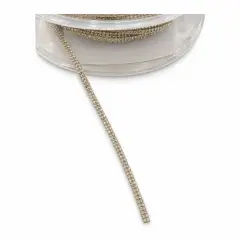 3S742Hot-fix trim, rhinestonesH 5 mm · two rows of 2 mm crystals · per metre
 3S474Hot-fix trim, rhinestones & lurexH 0.8 cm · per metre
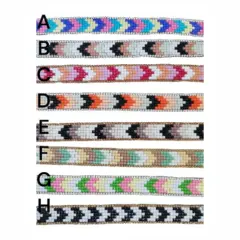 FC195Hot-fix trim, rhinestonesH 1.8 cm · per metre
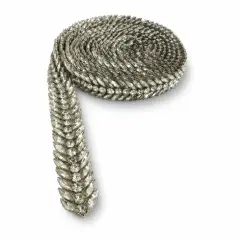 3S258Hot-fix trim, glass stonesH 2.5 cm · per metre
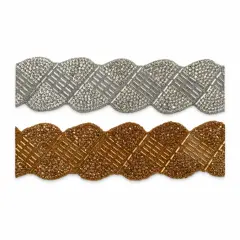 FC161Hot-fix rhinestone trimH 4 cm · per metre
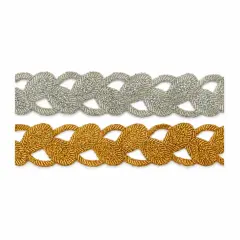 FC150Hot-fix trim, rhinestones & bugle beadsH 6 cm · per metre
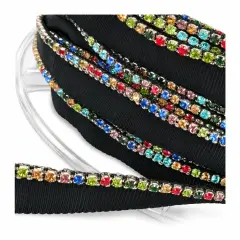 3S364Piping with rhinestone & bead chainH 1.5 cm · per metre
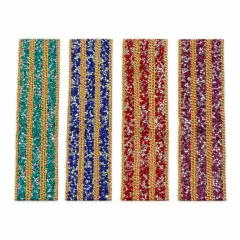 FC151Hot-fix trim, seed beads & chainH 5.8 cm · per metre
Workshop questions
- Can I order from the finished neckline measurement?
- Measure the actual placement line on the intended size and cloth. A trim offset from the neck edge follows a longer or shorter path, depending on the curve. Add joins after checking the sample.
- Is 8–10% enough for a matched motif?
- Measure one repeat, do a trial cut and multiply the actual loss by the number of runs. If repeat and join losses use up the allowance, calculate from the real cuts.
- How do I compare hot-fix trim with sew-on piping?
- Mount both on the same cloth and look at the face and reverse after the care trial. Measure the protrusion from the attachment line and check whether the armhole still opens as required.