Materials and application
Hot-fix or sew-on rhinestone appliqués for each fabric
How do the three 3 cm Crystal stars differ on the workbench?
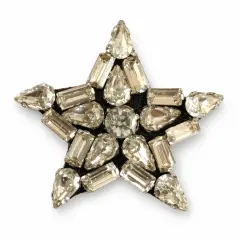
All three stars are sold per piece, with the same nominal diameter and Crystal glass stones. On 3S424, the stones are glued to the motif and the motif is hot-fixed to the fabric. 3S425 also has glued stones, with the motif applied by sewing. With 3S577 the stitches take into the felt backing. Cut three swatches from the same fabric lot and align the grain. Mark face and reverse before applying any of the stars.
When the knit stretches, the star resists and the load collects at its points. Felt gives the stitches a wider footing under the weight of glass. It also adds bulk and can stiffen a fine cloth. Hang the three swatches and bend them along the placement line. Look closely if anything moves. The failure might be an edge coming away from the cloth or one stone working loose from the motif.
When does a hot-fix transfer press mark the cloth or lose the bond?
Rib makes uneven contact with the platen. The raised ribs take pressure first and the valleys may bond poorly. Press relaxed jersey away from seam ridges that tilt the platen. Excess heat or dwell can reduce elastane recovery and leave a shiny square. Too much pressure can flatten the ribs and squeeze glue out, while low pressure or short dwell can leave the points free. Trial the settings in the application and fabric specifications. Record actual temperature, pressure, dwell, the press cover and which side contacted the platen.
On silk, chiffon, tulle and fine viscose use low-angle light to look for shine, yellowing, distortion and impressions through to the reverse. The shade can change even if the weave is intact. On water-repellent outerwear the finish can stop adhesive wetting the fibres. A bead of water gives you a clue. Use a bond and care trial to make the actual decision. If the cloth incorporates a membrane, assess what needle holes do to its function before specifying sew-on.
| Fabric family | Application to trial | Key risk | Catalogue codes |
|---|---|---|---|
Cotton sweatshirt fleece | Hot-fix on a flat area after a press trial. | Free points over brushed fleece or seam thickness, press mark on the face. | |
Stretch jersey and knitwear | Sew with distributed stitches. Trial felt backing on a stable area. | Crushed ribs, poor recovery and puckering around stitches. | |
Silk, chiffon and tulle | Light stitching with local support, on a sample. | Glazing or scorching under the press, snagged yarn and needle holes. | 3S425 on the intended support |
Wool coating and denim | Sew on, with felt backing where it helps carry weight. | Step at the edge or pull across the raised shoulder. | |
Coated or technical outerwear | Sew onto a compatible area or separate panel after functional tests. | Adhesive fails to wet the finish, needle holes compromise the barrier. | 3S425 on a compatible support |
When does a larger motif need more support?
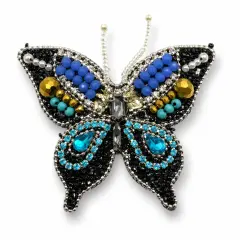
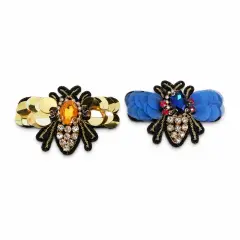
The hot-fix 3S018 butterfly is 7.5 × 6 cm with glass stones and hand-sewn ABS seed beads on the motif. Trial the ends of the wings near a dart or fold. If the fabric curls when you lift it from the press, try again on a flat area of the intended cloth. 3S279 is a 6.2 × 4.2 cm sew-on moth with glass stones, sequins and felt backing. Baste where the moth wants to twist before fixing the whole shape. Both are ordered by the piece.
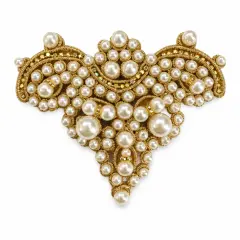
The 11 × 8.8 cm 3S735 shoulder appliqué is sew-on, with ABS pearls and rhinestones, sold per piece. Test it on the wearer with the bulk lining and reinforcement in place. An edge that lies flat on the table can roll out when an arm lifts. Spread the stitching over a supported area and check the lining still moves freely. On appliqués with raised prong settings, brush an offcut of the actual cloth over the stones to find where a prong picks up a thread.
Where does the appliqué go in the assembly sequence?
Before closing a seam, the panel sits flat under the press and you can reach the reverse with a needle. Mark the motif outline from the pattern and check where the seam allowance begins. Verify the position again after joining the panel. If the design ends at a seam, make the trial with the same layers as the garment. A single swatch and a seam intersection take heat and pressure differently.
For a lined garment, decide which layers the stitches catch and where to secure the ends. If the machine has to sew alongside the glass stones, check presser-foot clearance on the actual panel. Make up a short section and feel the reverse for threads that rub or stitches that emerge through the lining. Give the operator a picture showing the support, stitch start and finished position.
How do you run a useful pre-production care trial?
After the adhesive has cooled and rested for the time in its instructions, keep one mounted swatch dry as a control. Treat one for each application with the process intended for the garment’s care label. Have a decorated sample professionally cleaned if the garment will be dry-cleaned. A solvent such as perchloroethylene can affect ABS and decorative finishes. With glass stones, the coating, glue, thread and backing still need testing. Record the cycle so it can be repeated on the bulk lot.
To read recovery, mark a 100 mm relaxed length on a pressed swatch and on one that bypassed the press. Stretch each the same amount, give them the same rest and measure again. If one returns to 104 mm and the other to 101 mm, the first has kept more extension. Set an acceptance limit from the fitting, particularly at cuffs and necklines.
- Mark a known distance on relaxed cloth. Measure after pressing and cooling. For jersey, measure again after stretching and releasing it.
- Photograph edges and reverse before and after washing and drying. Look for loose tips, glue halos, colour transfer, slack stitches and moving stones.
- Open the garment and bend the decorated area as it will flex in wear. Record catches along the edge or shrinkage around the motif.
- Record method, revision, lot and approved conditions. Add trial material and replacements to the bulk consumption. Repeat the trial if fabric lot or finish changes.
Referenced catalogue articles


Workshop questions
- Can I use the same press time for all wholesale hot-fix appliqués?
- Run a trial for each adhesive, cloth and thickness combination. Check the supplier’s heat, pressure and dwell instructions. A thick seam affects both the heat transfer and where the platen makes contact.
- Will the sew-on star work on any tulle?
- Test the intended needle and thread on the actual mesh. Add a compatible local backing if the stitches pull the mesh. Inspect the hanging garment and check for a raised patch on the reverse.
- Why does a stone move while the patch edge still holds?
- There are two joints. Check the bond or stitches between the motif and the cloth, then the fixing of an individual stone to the motif. Note which joint moved.